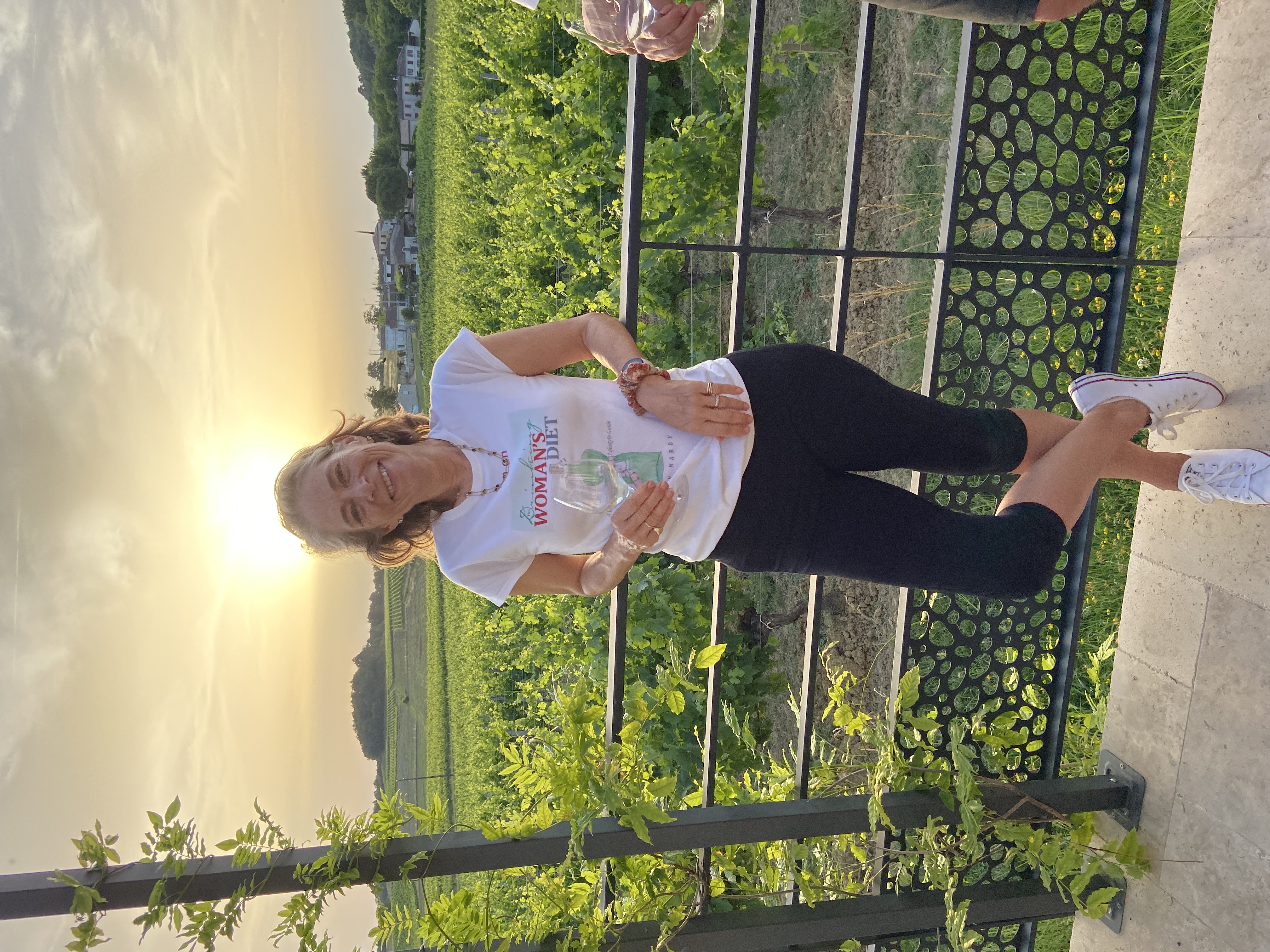
Sally Evans uncorks vegan wine.

Wine is made from grapes, so it must be vegan right? Or is it? Today’s guest post from Sally Evans owner wine maker at Château George7looks at what exactly makes a wine vegan. Sally is vegetarian, not vegan but she takes us through her wine making choices to make Château George 7 wines accessible to as many wine lovers as possible. Let me hand over to Sally.
I used to assume (like most) that wine is made of just grapes and so automatically suitable for vegans. But since becoming a wine producer and subsequently a vegetarian, I have realised there is much more to it. During ‘Veganury’ (and beyond), more and more people are trying to eat a more plant-based diet or even give up animal products all together. But do we know whether the wines we drink are vegan or suitable for vegetarians? And is there a difference?
I am a vegetarian winemaker; this was one of the driving factors behind collaborating with Wendy to create wwww.wineand2veg.com. I struggled to find good advice on wine pairing suggestions for plant-based dishes with far too much focus on pairing Bordeaux with beef. With the growing trend (plus health advice) towards plant-based eating, the wine world needs to ensure it is including these consumers.
A general consensus on the vegan wine definition is ‘a wine not having been made or come into contact with anything derived from an animal source’. Here, I try to break down the mystery around winemaking so that drinkers of my wines really understand what happens in the process. Here are some of the decisions I have made and some things you might not have thought about when considering whether a wine is vegan-friendly:
Fining
Let’s start with the obvious – fining for clarification and stabilisation. Fining involves adding a product at final stages of wine making, after filtering and before bottling. It passes through the wine and any remaining tiny particles in the wine stick to it. These particles together with the fining agent create a sediment that is then removed. Traditionally derived from fish eggs or egg white or casein (a milk protein), the fining agent passes through and none should remain in the finished wine. However, if there’s the slightest chance a touch of the fining agent is still present, then things get sticky because an animal product has been in contact with the wine even though it is taken out afterwards. While vegetarians might not object to egg white, vegan-friendly fining options include a pea protein or bentonite. Alternatively, don’t fine at all. Here at Château George 7, we have never fined our red wines. For the ChâteauGeorge7 white, we tried bentonite but now we don’t fine the white either – we simply filter and bottle.

Clearly white George 7 Blanc
MOG
Now for one you might not have thought of. Wine is just made of grapes, right? Technically yes, but apart from the obvious yeast or sulphur, some wines have other things added to them depending on where in the world they are made. Here in France, we have very strict regulations on what can go into wine, which is very little. I can’t speak for all wine production worldwide, but in the main, additives don’t tend to involve animal products. But how about accidentally? Anyone working on a sorting table during harvest where the grapes are machine harvested will be amazed at the amount of MOG [matter other than grapes) that rocks past as red wine grapes head for fermentation – snails, lizards even baby snakes or parts thereof. (Aside: I love the fact that the vines are teeming with lots of wildlife). If some bits get through, they will be removed with the grape must after fermentation, or at worst during filtering. But they have been in contact with the wine during its production albeit by accident and in very small amounts.
For hand-picked grapes it’s different, pickers inspects individual bunches but even then, some insects might get through the initial phases. At Château George 7, in addition to manual sorting, we use an optical sorter, a sophisticated piece of equipment adding another level of sorting which inspects each grape for size and colour (thanks to computer pre-programming) and ejects anything that doesn’t conform. Not everyone uses an optical sorter though.
Animal input
Then it starts getting more complex depending on why you are vegan or vegetarian. Is it for health or environmental and sustainability reasons? Or is it a principle against the commoditisation of animals? (And they are linked). Or perhaps religious reasons?
Vegan or vegetarian-friendly has nothing to do with being organic – that is a different topic even if there may be overlap in the approach and guiding principles of the producer. Biodynamic viticulture follows many practices that are in tune with nature – from being guided by the moon to growing, making and using natural treatments based on specific plants. The practices of burying a cow horn filled with manure or using deer bladders for a yarrow preparation are unacceptable to many vegans because they require the rearing of animals for its parts i.e. commoditisation rather than a happy by-product of an animal’s natural existence. This is a real debate.
From soil
I use organic fertilizer on the vines and I switched from one made from fish by-products to one that is plant-based because I couldn’t be 100% sure that the fish weren’t farmed for that primary purpose. I made the switch to a plant-based one to be safe.
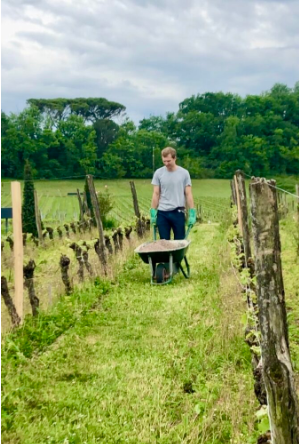
Getting dirty or clean in the vines?
Fertilizer goes into the ground, not the wine so does it matter? Some purists hold out that any process linked to the environment where the wine grows or is created should not be involved in the ‘commoditisation’ of animals however well they are loved and treated when living. What about working horses in the vines? Does this make the finished wine unsuitable for vegans if the horses exist for that purpose and their efforts harnessed to support wine production? Is this taking it all a bit far? Read on.
To cork
What about packaging? We don’t tend to consider whether a vegan sandwich is in packaging sealed with glue made from animal by-products, we assume that the food is neither touched nor affected by an animal derivatives (the glue might offend a purist’s principles). Natural glues using animal parts have been made for centuries while synthetic ones are common and made from plastic polymers, but they don’t break down easily. Sustainability or vegan – the two aren’t always one and the same (nb from Wendy, check out Sally’s blog posts on her sustainability choices). As natural vegetal glues exist, I considered whether something I am using is in direct contact with the wine, giving the slight possibility that some of the animal product could be absorbed into it (as the case with fining).

Blue sky thinking, finding the right cork
What about the cork? I was delighted, on producing my first Château George 7 Blanc in 2020, a white wine made for early drinking rather than for ageing, to discover a new agglomerated cork(offcut real cork pieces hence more sustainable) bound together by only vegetal polyols including beeswax i.e. no animal products in the glue. But would vegans object as some wine touches the cork which has used a product from bees?
Just in case, I solved this by switching the following year to another new cork bound by a glue made from discarded grape remains (skins and pips). Most people won’t consider that bees are commoditised for their beeswax because they are not ‘harnessed’ to work but others disagree. I avoided the issue thanks to a great alternative and I do like grape ‘waste’ being put to good use. Not an animal product in sight (or touch).
Communication
We‘ve seen, the debate is broader than wine clarification. As producers we need to keep up the communication and not be mysterious about how we make our wines, allowing the consumer can make up their own mind, especially now as more people are becoming vegetarian or vegan. There is a relatively recent independent certification scheme called EVEVegan which covers all products and not just wine. However, a number of producers and others in the wine trade I asked hadn’t heard of it. I don’t feel it’s a certification that warrants my personal investment until it becomes more widely recognised – we already have enough schemes/logos that the consumer doesn’t understand, it’s simple enough to put vegan on the back label. As we move to obligatory ingredient labelling in the EU, this step change for the wine industry can also offer producers the chance to be open regarding whether their wines are suitable for vegans (although it’s not part of the new legal requirement).
What’s your why?
It comes down to why you are vegan, whether you consider anything that harnesses animals in the production process renders a wine out of kilter with your principles. With this as for other decisions when creating my wines, I have delved into each step of the process to make my own informed decisions, decisions I am happy with. Get to know producers of the wines you drink and what they do, only then can you be sure where animals and their by-products have come into contact with the wine you are drinking and if they really are suitable for vegans or vegetarians.
I want Château George 7 wines to be available to as wide an audience as possible. Vegan, vegetarian and anyone who enjoys a delicious glass of wine made with care and attention. Cheers.
The original version of this post can be found on The George 7 website. Sally and I have created the website Wineand2veg suggesting seasonal wine and plant based food pairings. Making sustainable wines of Bordeaux more accessible to anyone looking to get more plants on their pates and to look at how wine can be part of a healthy lifestyle.
If you enjoyed this, please sign up to receive future blog posts directly to your in box and don’t hesitate to post comments and questions below, I love hearing from you.