Sustainable drinking

Is selling alcohol sustainable? This is a tricky subject, especially for my audience of wine drinkers and producers. I’m not talking about economics; I’ve touched on that in a previous post – but the ethical and moral case for or against selling a drug – or a poison – depending upon who you listen to.
To make my position clear, I am not a sober evangelist, I don’t even do dry January, I earn a living from talking about and tasting wine. I am however a proponent of moderate and responsible drinking.
There’s no getting away from the fact there is a growing neo prohibition movement both in the UK and in the USA. I first came across this surprising trend when Michela Rodendo explained the creation o of Women for Wine Sense. In 1990, she and Julie Johnson were both working in wine in California and were shocked when their children, following a discussion in school, returned home to ask why their mothers were making drugs.
They created Women For Wine Sense to discuss promote moderate wine consumption as part of a healthy lifestyle, and to highlight the need for balanced information in warning labels on wine bottles. They were instrumental in Congress declaring American Wine Appreciation Week in April 1993. Today the organization concentrates on wine education and relationship building for industry professionals and enthusiasts and funds scholarships for women in wine-related fields of study.
Anti-alcohol or anti alcoholism
I may be suffering from frequency bias, but anti-alcohol lobbies seem more and more common with a plethora of anti-drinking apps, organisations and communities; Soberistas, Alcohol Health Alliance UK, Alcohol concern, Drink Aware, Join Club Soda, and apps such as Drink coach. (Their2-minute test 1can be a bit of an eye opener.)
Dry January started in the UK in 2013 and was registered by Alcohol concern in 2014 and has since spread across Europe thanks to social media campaigns by cancer and anti-alcohol organisations. In 2019 10% of the French population signed up to the ‘Defi de Janvier’. Sober October is similar, encouraging people to go booze-free in October to raise money for Macmillan Cancer Support. There’s a clear health message behind these initiatives.
What do these movements achieve? What are their objectives?
There’s not one single theme, some are evangelical prohibitionists, others proponents of healthy drinking and still others political lobbyists. The Alcohol Health Alliance UK is a powerful group of organisations with the stated aim of reducing the harm caused by alcohol. They are campaigning for (I quote from their website) :
A minimum price of at least 50p per unit of alcohol
Health warnings and nutritional information on labels
Restrictions on alcohol marketing to protect children and vulnerable people
A fairer and healthier alcohol duty system
Better access to specialist support for at-risk drinkers
There is a genuine concern and dry months allow people to realise that they can become more mindful about how and what they consume and even live without drinking.
The WHO (World Health Organization) is urging member states to restrain access to alcohol with Minimum Unit Pricing now in place in several member states. As of February 2023 in the UK, wine will be taxed on its alcoholic strength, rather than by volume. The current system is thought to encourage stronger drinks because all wines and ciders are taxed at the same rate regardless of alcohol content. The current three bands of taxation will be replaced with 27 different rates based on 0.5 per cent increments of alcohol by volume, creating a bureaucratic nightmare for companies. The only upside for consumers is that sparkling wine will benefit from a tax reduction to the level of still wines.
Public order or public health
Prohibition in the US in the 20s was motivated by a moral, ethical, religious and public order agenda, today’s neo prohibition or neo abstinence movement is linked to a public health agenda.
Booze and health
According to Santé Publique France, 41 000 deaths can be attributed to alcohol every year in France and the Alcohol Health Alliance claim 70 people die every day in the UK from alcohol-related causes. The International Agency for Research on Cancer (IARC) states alcohol consumption is the third leading risk factor for disease and mortality in Europe, after tobacco and obesity. In Europe, an estimated 10% of all cancer cases in men and 3% of all cancer cases in women are attributable to alcohol consumption. Well behind obesity and the related issues.
But not wine surely?
Many of us take it for granted that that wine is a healthier option compared to spirits. Plotting mortality rates against drinking creates a J-shaped curve, indicating that moderate drinkers seem to live longer than teetotallers but that any benefits decline rapidly with excess. An American doctor in the 1980s coined the phrase ‘The French Paradox’ when finding that despite a high-fat diet, the French have lower rates of heart disease than Americans, with a fellow doctor from Bordeaux (where else) they attributed the difference to a moderate consumption of red wine. The reputation of the health benefits of red Bordeaux has not looked backed since.
We now know that sugar, rather than fat, is the major cause of heart disease and the counterargument to this positive role of alcohol on health is that moderate drinkers tend to also have other positive lifestyle factors, including exercise and a healthy diet (fruit and veg) and tend not to smoke.
A recent studyshowed the wine drinkers spent a higher percentage of their food budget on healthy food over unhealthy food than the control group, Bordeaux wine drinkers topped the scale at 58.3 %). In contrast smokers tend to have a less healthy lifestyle which skews the stats against tobacco even more.
Dose related
The higher the amount of alcohol consumed, the higher the risk of developing cancer. Why? Ethanol (the form of alcohol found in alcoholic beverages) is a procarcinogen, i.e. a substance that transforms into a carcinogen through metabolism. The body breaks ethanol down into aetaldehyde which is the carcinogen. If not present in excess this can be quickly broken down into harmless acetic acid and then into carbon dioxide and water. This is where excess becomes an issue, too much and the liver can’t remove acetaldehyde from the body. When the liver is preoccupied with metabolising alcohol it struggles to do other important things like control cholesterol and hormones such as estrogen and insulin, which may also affect cancer risk. It might also adversely affect the gut micro biome.
How much?
Government recommendations vary but no more than 14 units spread over a week, with 2 days off and no binge drinking is the consensus. Some studies say there is no safe level, although it’s hard to measure as studies are often based on self-reporting and when questioned, we all lie about our alcohol consumption. Don’t we?
The way these studies are interpreted varies depending upon the commentator, as comparisons by Alcohol Health alliance and the Wine Information council show.
The economies of booze
The Alcohol Health Alliance states alcohol harm costs NHS (National Health Service) England £3.5 billion annually. The economic argument is a difficult one, in 2021/22, tax receipts from alcohol duties in the United Kingdom reached 13.1 billion British pounds, (12.1 billion in 2020/21) of which wine duties accounted for the highest share 4.4 billion pounds in 2021/22. Can you put a price on health?
Investment
In France, wine is an integral part of the economy. It produces 12 Billion euros of income, just behind aeronautical engineering, and employs 500 000 people.
At the Areni Fine Wines for Fine Minds conference in Bordeaux a few years back, an investment banker warned industry delegates that, as investment funds moved away from arms and tobacco, they were now also looking at alcohol companies with a jaundiced eye.
A cultural and social exception
It’s also part of the culture. Living in Bordeaux, it’s unusual not to see a bottle of wine on a table with meals. This is changing, as wines get higher in alcohol, consumption in France is decreasing. I’m not claiming this is cause and effect. As the French population becomes more urban, they drink less wine, cheap low alcohol wine is no longer considered as a ‘food’, wine has moved to a luxury status a ‘nice to’ rather than a ‘need to’.
World wine consumption is decreasing, in 2020 was estimated at 234 mhl, a 3% decrease compared to 2019. This is the lowest recorded level of consumption since 2002.
The proportion of adolescents self-reporting alcohol use had been declining for the past 20 years in most developed countries. Trends show a general diminishing of abuse or binge drinking amongst young people, but not older generations.
The fact younger people in France are drinking less worries the wine trade. Could communication around responsible drinking and wine as a cultural product help?
Do consumers even care?
All these organisations, trade or otherwise, agree that excess alcohol consumption is dangerous but what about the consumer? They are aware of the link between liver disease and excess alcohol consumption, but less so for cancer. Consequently, current anti-alcohol campaigns are concentrating on cancer prevention.
In general people consume wine for pleasure, not to get drunk. That might be a side effect, but the genteel image of wine can mask a drinking problem, especially when you look at those drinking recommendations.
What should or can the drink industry do?
It is imperative that the industry promotes moderate and responsible drinking before legislation takes it out of our hands. The tobacco industry offers a vivid example. They tried to hide the harm tobacco does to health and suffered its subsequent demonisation and lash back. There is no upside to smoking however t and secondary smoking is also a risk, but no wine producer wants a picture of diseased liver on their wine label or even a generic white label or bottles hidden on a top shelf.
Already, advertising options are limited. Wording and images are carefully controlled, no sponsorship of sporting events, and in France, no alcohol advert can show the image of anyone who is not directly linked to production.
Demonisation
As anti-alcohol organisations demonise the product even further, can we counter balance the criticism with clear communication around wine and its moderate consumption?
Labelling
Labelling legislation around alcohol is complicated and varies from country to country. Any wine maker will tell you of the headaches of adhering to country specific labelling obligations. Wine must mention the alcohol level on the label, but again, tolerance varies from country to country. In the United Kingdom, alcoholic beverages are measured in ABV (alcohol by volume) as a percentage. EU regulations permit a tolerance of plus or minus 0.5 per cent; US regulations allow a tolerance of plus or minus 1.5 per cent of alcohol for wines under 14 per cent alcohol, and plus or minus 1 per cent for wines over 14 per cent. A US wine label of 13.5 per cent could contain 15 per cent alcohol.
Wine has so far been exempted from ingredients labelling that other foodstuffs have to abide by. It’s made of grapes, right? New legislation means calories will need to be on labels for wines sold within the EU and there’s discussion around sugar level labelling, especially for sparkling wines.
There will be no need to list processing aids or winemaking processes, a huge relief as it would make for long lists on small labels, but the clean wine debate (see previous post) shines a light on industry failings to respond to some clients’ demand for information about exactly what they are drinking.
The CEEV (Comité Européen des Entreprises Vins) is getting ahead of future changes, they have created global U-label platform using QR codes, this allows producers to list all ingredients used and provide automatic translation in the language of each European country. It is open to any wine or spirit company, big or small, based inside or outside the EU, who can use e-labelling to increase transparency through digital information direct to consumers.
There are industry initiatives already in place
The OIV (Organisation International du Vigne et du Vin) is an association that covers 48 member countries that account for 86% of global wine production and nearly 71% of its consumption.
Statistics and lies self-reporting
For over 10 years, they have been working closely with the WHO (World Health Organization) to improve data around alcohol. Their “Safety & Health” commission works on identifying and analyzing trends in consumption, collecting and sharing scientific information on responsible and moderate consumption and encouraging research into the effects of wine consumption on human health.
In their publication «Dietary and lifestyle habits of drinkers with preference in alcoholic beverage. Does it really matter for public health?», they don’t deny the detrimental health effects of heavy drinking, but they do highlight inconsistent findings around light-to-moderate alcohol consumption.
They conclude that healthier diet and lifestyles are generally observed in light-to-moderate alcohol consumers, especially when wine was the preferred beverage. Age, gender and socio-economic status were shown to be compounding factors in the association between alcoholic beverage consumption and health outcomes.
They are involved in the WHO Global strategy to reduce the harmful use of alcohol and contribute to the development of the 2022-2030 action plan to reduce the harmful use of alcohol. They have adopted prevention guidelines such as best practices at consumer wine events and voluntary breathalyser tests. Although wineries and tastings rooms are not legally obliged to offer tests, it’s encouraged, if people are drinking a lot. If someone leaves a license holder and causes an accident through excess alcohol, the license holder may be held responsible.
The CEEV, Comité Européen des Entreprises Vins is the representative professional body of the EU industry and trade in wines, comprising 23 national associations. Their mission is to lead and coordinate dialogue within the international wine sector and to defend the interests of EU wine companies in all policy areas. They too are tackling moderate and responsible consumption as a founding member of The Wine in Moderation Programme.
Wine in Moderation works with the Wine Information Council to offer Science based facts and solutions away from sensationalist reporting and fake news. Irrational health claims around wine by certain marketers and producers really don’t help.
This social responsibility programme launched in 2008 to encourage a sustainable approach to presenting wine. It gives professionals tools to responsibly present wine, encourage moderate consumption and to get ahead of restrictive legislation.
A gateway drug?
It’s not easy, what producer wants to talk about their product causing harm? Wine producers see their products as part of a cultural and even historical tradition, a product of a passion and a place, not as a means of intoxication. Alcoholism might be an unintended side effect, although alcoholics will rarely reach for a bottle of fine wine to assuage their need, some consider it a gateway drug.
Size matters
Increased sized serves are targeted, especially in the context of 14 weekly units limit suggested by governments. A 750ml bottle of still wine (ABV 13.5%) is 10 units, a small 175ml glass of wine (ABV 12%) is 2.1 units and a large 250ml glass of wine (ABV 12%) is 3 units. If you’re sticking to government guidelines one glass and you’re out!
Winery tasting rooms rarely use the large glasses you see in bars and restaurants, guests are normally offered several small servings to compare and contrast, and of course there are spittoons.

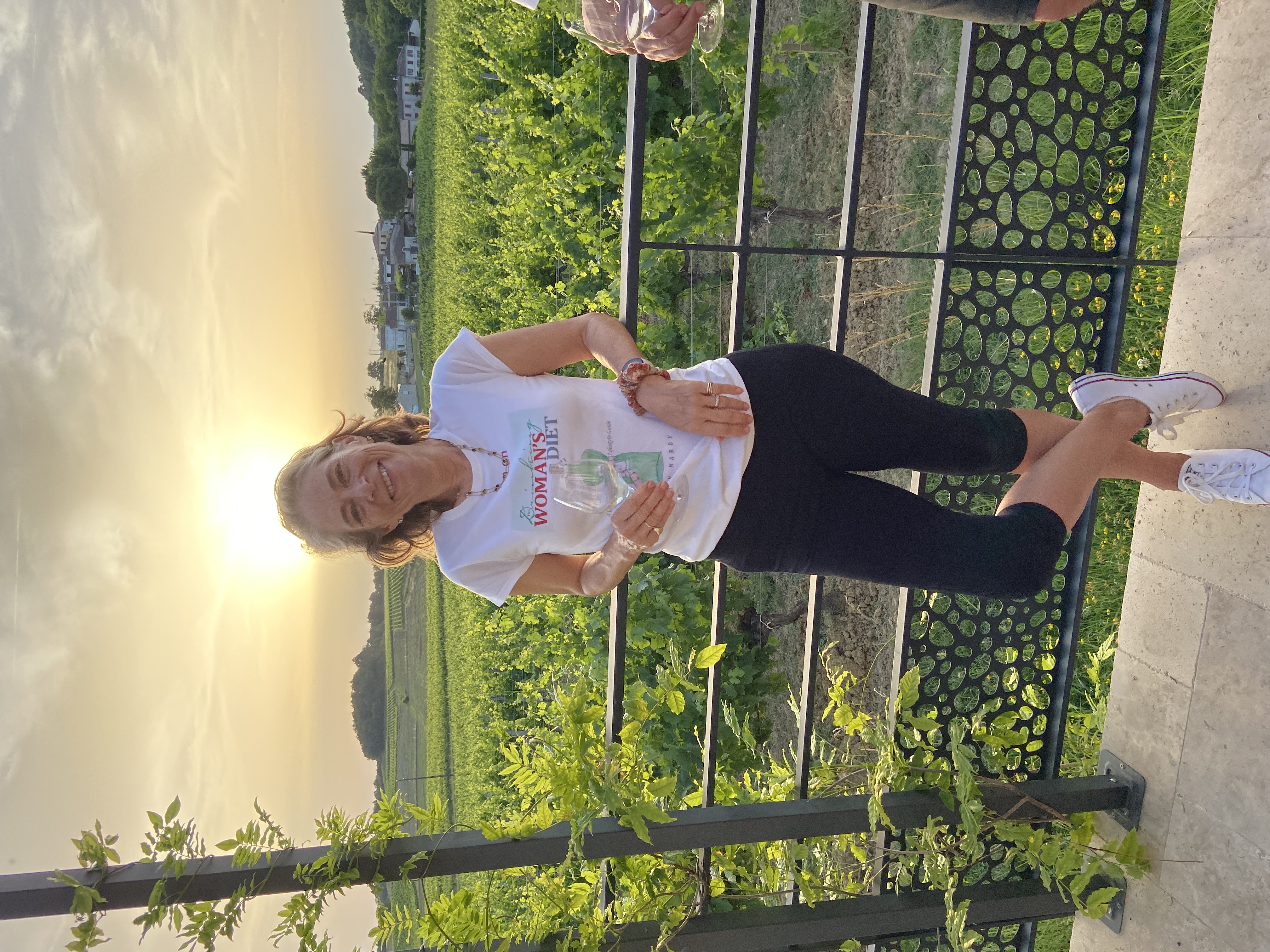
Glass half full? Tasting at a winery.
Food and wine
We know that drinking on a full stomach reduces the impact of alcohol and slows down it’s absorption and many wineries in Bordeaux now offer food and wine tasting experiences. There may be an array of glasses at a wine lunch or dinner but paired with food the servings are seldom large and rare is the wine producer that finishes them all – watch next time.
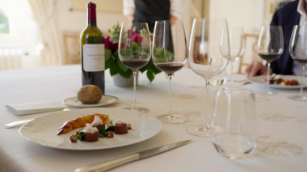
Food with wine
The pleasure of a good wine with food, around a table, sharing the story of the wine or just taking the time to enjoy wine can’t be discounted. Wine is a convivial product, and as we know social connection is also important for health.
A near miss
At the beginning of this year, the European Parliament Special Committee on Beating Cancer released a report focusing on the need to fight harmful alcohol consumption. Fortunately, they adopted a text that differentiates between moderate and harmful consumption. It was a near miss, labelling could have become much more restrictive and sensationalist, the idea of images of oesophageal and liver cancer on labels was mooted.
Ignacio Sánchez Recarte, Secretary General of CEEV, promotes the use of information instead of unjustified health warnings. He said ‘The industry must be seen to fight against the harmful consumption of alcohol, and promote a sustainable culture of wine and a responsible wine consumption’.
It’s not over, the European Commission is working on the legislative initiatives from the Europe’s Beating Cancer Plan Implementation Roadmap. The CEEV is lobbying the Commission to focus on harmful consumption of alcohol and ‘avoid disproportionate policies that will harm the wine industry and the communities that depend upon it’.
A healthy passion for wine
As a wine educator, I remain convinced that encouraging people to learn about wine also encourages a more mindful approach to drinking. Building a respect for the product as well as consumer health. Wine Tourism helps too, receiving people at vineyards is an occasion to share a passion for the product. We can present the positive aspects of drinking without encouraging alcoholism.
Although science and statistics show that a moderate wine consumption can be part of a varied, balanced, healthy diet and lifestyle, the health argument is not a marketing argument, and you should not see producers put it forward. They should leave that message to sensationalist journalism.
As a wine consumer, I don’t drink wine because of its health benefits. I drink wine because I love it, I love the culture, I love matching wine with food, I love the stories and the history behind it, the places it is made and the people who make it. It’s a passion but I am well aware of the importance of promoting moderate wine drinking. I’ve even written a book about it.

The Drinking Woman’s Diet.
As a wine educator I remain convinced that helping consumers understand wine can also encourage healthy drinking habits, taking take time to discover, savour and enjoy rather than drinking without thinking. If consumers are drinking less (and we’ve seen they are) they can afford to drink better. It could be the beginning of a healthy passion for fine wine.
Please sign up here to receive future blog posts delivered directly to your inbox.
To learn more about Bordeaux, you can buy Bordeaux Bootcamp here, and to learn more about Wine and Wellness read The Drinking Woman’s Diet here.