Women in Wine Margaret River

In my last post from Margaret River, I highlighted the important role Vanya Cullen has and continues to play in the sustainability movement in the region. Vanya is far from being the only dynamic woman in wine here. It seems you can’t enter a cellar here without meeting an innovative woman, although my choice of properties to visit might’ve had a slight bias.
Our very first visit to a Margaret river winery was to Lenton Brae where wine maker Vanessa Carson received us alongside viticulturalist Russel (Russ) Cooker. There’s several links to Bordeaux at Lenton Brae. Back in 2000, Vanessa won a prize at university to work a vintage in Bordeaux at Beau-Site in St Estèphe. Vanessa was only there for a few months, but it was an eye opening first experience of working in a vineyard and winery. It obviously didn’t put her off, she has been the wine maker at Lenton Brae since 2021 as well as consulting for Plan B! Wines since 2016 and Green Door Wines further north in Bunbury.
Russ told us about their Cabernet and Merlot clones, the first in Margaret River sourced from Bordeaux, no mean feat given the Biosecurity laws in the region. In all they have 19 different clones across their vineyard, that gives them flexibility to adapt the blend with every vintage.

Part of the Lenton Brae range
Lenton Brae is on the famous Caves Road in Wilyabrup, where the deep gravelly loam over clay soils are perfect for Cabernet, but Lenton Brae is also a white wine hero. 60% of the 9 ha vineyard is planted to white varieties. Chardonnay clones from Burgundy are planted alongside the famous Margaret River Gingin clone on cooler Eastern facing slopes of the Brae (Scottish for hill), planted east to west to maximise shading.
In 1987, their very first wine was a Semillon Sauvignon Blanc blend (SSB), and they have just bottled their 37th consecutive vintage. These Bordeaux varieties enjoy the maritime influence and the well-drained soils. Vanessa says their style is inspired by white Graves, aged on lees with 25% fermented in French Oak of various sizes (something we saw in almost all cellars), including 500l ‘puncheons’ that give a gentle oak impact when blended with tank fermented wines. SSB fell out of favour for a while in the region but Lenton Brae never turned their back on it. They are also the sole producers of Pinot Blanc in WA, possibly the only ones in Australia.

With Vanessa Carson and Russ Cooker
Their premium wines are sold under the Wilyabrup Label. Previously planted to Merlot & Pinot, it is now dedicated to Cabernet Sauvignon and Chardonnay. The Sauvignon Blanc fruit coming from further south in cooler Karridale.
The estate range is classic Margaret River single varietal wines but also a Touringa Nacional, their famous Pinot Blanc and a delicious 100% Chardonnay Sparkling Blanc de Blanc.
The In Good Hands range is where they have some fun, experimenting with more single varietals.
Vasse Felix Lucky for some
Further along Caves road, still in Wilyabrup, their neighbour Vasse Felix, offers guests a brochure with a series of illustrations that clearly explain harvesting and wine making. Once the grapes enter the cellar, the cartoon figure of a Bart Molony, Chief Viticulturist bringing in the harvest is replaced by a woman with long flowing locks – that’ll be Virginia.
Virginia Willcock has been with Vasse Felix since 2006 and her influence in the winery is clear, as it is across the region. This 2024 is her 18th vintage in Vasse Felix, 33rd in Margaret River and 38th in her lifetime with 4 in Italy.

With Virginia Willcock in cellars of Vasse Felix
The cellar was full of different sizes, shapes and materials of fermentation vessels, illustrating her love of experimentation. Virginia fermented her first Cabernet and Malbec batches with indigenous yeasts in 2012 and by 2018 all of her red ferments were wild and almost all of her white ferments too (Chardonnay of course but also Sauvignon Blanc and Semillon). She finds wild ferments add complexity and nuances in the wine that the unique microbiology of the land brings. She’s doing some carbonic whole bunch fermentation with her Syrah and some fermenting on the skin for the Sauvignon Blanc. There are a few open ferments, and a couple of 1800 litre Cocciopesto vessels called the drunken turtles.
The same experimentation goes for ageing, there’s French oak from diverse origins, of different ages, rarely 100% new and many different sizes including 1000l Garbelotto French oak vats, 225l Bordeaux barrels, 228l Burgundy pieces, 500l puncheons, 1000l vats and 3000l foudres, clay amphora and concrete eggs. It’s nothing if not diverse.

Some of the tools of the trade at Vasse Felix
There’s plenty of wines for Virginia to play with, their wide range is presented across three levels that they explain as, Good to Better to Best, but represent three different styles of Chardonnay and Cabernet although all three Cabernets are technically a blend of Cabernet Sauvignon and Malbec.
The Classic Range includes a Dry White, Dry Rosé and Dry Red. The Filius (son of) range showcases Cabernet Sauvignon, Chardonnay, Shiraz and a Sauvignon Blanc Semillon blend. The Premier Range includes Cabernet Sauvignon, Chardonnay, Syrah (See the nuance Shiraz/Syrah) & Sauvignon Blanc.

Part of the Vasse Felix range
Their two Icon wines are Tom Cullity, the red Bordeaux blend named in honour of the founder, and the Heytesbury Chardonnay named after an ancestor of the Holmes a Court family, owners of Vasse Felix since 1987.

and some of the icons
Vasse Felix just celebrated the 50th vintage of their Cabernet Sauvignon it owes its origin – as does Margaret River – to Dr Thomas Brendan Cullity (see previous post). Working in the UK as a cardiologist in the 1950s, he developed a taste for European wines, coming home he was inspired to try to produce something similar. It seems Tom Cullity and Kevin Cullen may have discussed planting a vineyard together and Kevin helped Tom negotiate the purchase of the Vasse Felix Vineyard site with the original owner before then going on to create his own Cullen Vineyard.
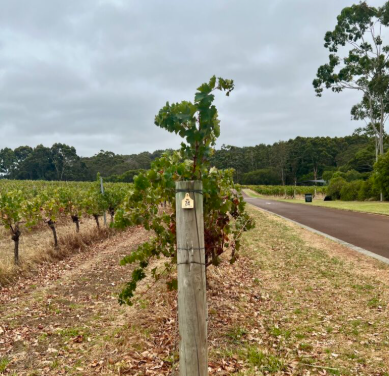
Cabernet Sauvignon at Vasse Felix
The name Vasse comes from the unfortunate sailor Thomas Vasse who fell overboard in Geographe Bay in 1801, and Felix meaning lucky or ‘blessed. Their icon is a Peregrine falcon, the raptor they originally tried to use to control vineyard pests.
From the original 8 ha the property, vines are now across four vineyards covering a total of 300ha. The original vines were cuttings of Cabernet Sauvignon, Malbec, Syrah and Riesling from Jack Mann’s Houghton Vineyard in Swan Valley further North. He slept in a shed in his newly planted vineyard and made the first serious wines of the region in the 70s.
The original 57 year old Cabernet Sauvignon vines in ‘Toms Block’ are the Houghton ‘Heritage Clone’, well established in WA (Western Australia) since 1800s. It left France pre-phylloxera and is still grown on its own roots here at Vasse Felix. The original Malbec and Syrah are still there too although it’s been grafted to Cabernet and back again!
‘Great Wines forever’ is their sustainable philosophy and long term vision. They dry farm the estate to build resilience for the ‘tough’ Cabernet Sauvignon. This was brought into the sharp focus with their 2024 vintage, more than one month early with lower yields faster ripening.
Chardonnay and consistency
Most of the Chardonnay at Vasse Felix is the Gingin Clone, imported from UC Davis in the 1950s and characterized by small bunches of ‘chicken and hen’ berries or Millerandage. In Bordeaux this would be seen as a massive inconvenience, here they love this mix of berry sizes as it maintains acidity and gives intensity to the fruit. Relatively late to the ‘Chardy Party’ they planted in 1987 and produced their 1st Chardonnay in 1990, they now have 38 plots of Chardonnay. Until 1994 they sold their Syrah as Hermitage, now it is Vasse Felix Syrah, not Shiraz, reflecting the elegant style they are looking for.
Sparkling
Although 75% of their sales are in Australia, of which 20% directly from the Estate, just 25% goes to export. the UK is an important market so for UK readers you might just be able to find some. I recommend their Sparkling Idée Fixe, it was the perfect start to a simply spectacular lunch in their restaurant.

We met Ellin Tritt, winemaker at Frazer Gallop thanks to Sean Blockside of Margaret River Discovery, on our adventure tour. Ellin was knee deep in vinification. From nearby Bunbury and passionate about wine since she was a young girl, she completed a double degree in winemaking, viticulture and agribusiness before doing vintages in Canada, Provence, Alsace and the Napa Valley. Her experience reaches across Margaret River with Xanadu, Watershed Wines, Naturaliste Vintners and Vasse Felix before joining the team here at Fraser Gallop Estate in 2017 where, with Clive Otto, she makes Cabernet Sauvignon, Chardonnay and Semillon, Sauvignon Blanc blends using minimum intervention and indigenous yeasts. The vines are dry farmed on the same Wilyabrup terroir. They use Bordeaux barrels for the Cabernet Sauvignon and Semillon Sauvignon blanc blends, and Burgundian coopers for the Chardonnay.

Ellin explains the 2023 at Frazer Gallop – great T shirt!
This is the closest we came to anything resembling a Bordeaux chateau, an elegant property amongst the vines, where Sean organised a lunch under the trees and a tasting of the range of wines from this boutique winery including Their Palladian range – a reference to the architecture of the ‘chateau’.

The nearest thing to a French Château
Keeping Margaret River weird
Just the other side of the town of Margaret River, Jo Perry is another MR woman wine maker having a lot of fun. And it shows in the multitude of references all brilliantly illustrated with labels by Tasmanian artist Sean Edward Whelan. You can enjoy his art on her website too.

The amazing artwork of Sean Edward Whelan
Jo Perry handcrafts each wine in an anonymous looking building on the outskirts of the town, which has been mistaken for a tattoo parlour – see the illustration on the door. Although the wines are fabulous, the labels alone are worth the purchase! Her winery is her playground, and you can tell she’s enjoying herself and when you visit, tasting from the myriad of vats, barrels amphora and more, it’s contagious.

Jo, amphora and friends at Dormilona
Dormilona means ‘sleepy head’ in Spanish, but there’s nothing sleepy about Jo, she never stops! She started wine making at 14 years old at Cape Mentelle thanks to her Grandfather. She has made wine in the Rhône, Burgundy, Bordeaux (Côtes de Castillon for Direct wines before heading to Spain for them), New Zealand and California, before coming back to Margaret River, she managed the winemaking operations at two wineries in Galicia, hence the Spanish connection.

She created her own label in 2012, using mainly organic and biodynamic, fruit, but dropped the organic certification, the wait was too long, and she’s got stuff to do! She adheres to the principals though with no synthetic inputs, sheep grazing in the vineyards in winter and chicken manure spread through the vines.
Her wine making is minimalist and experimental with skin contact on whites, fermenting and ageing her ‘Clayface’ label of Cabernet and Chardonnay in amphora and clay eggs. She loves stainless steel and neutral oak puncheons and barrels anything that allows the fruit to shine.

Here’s looking at you, Clayface
Her house wines are called Blanco (Semillon), Tinto (Shiraz), Orenji, (80% Semillon, 20% Sauvignon Blanc fermented on skins for 2 to 3 weeks) and Pinku – no confusion there as to what’s in the bottle despite the skull and crossbones on the label. The Yokel range is made from fruit from the Swan valley with profits going towards saving the endangered Western Swamp Tortoise, native to the Swan Valley. An artistic rendition of said turtle graces the labels of the Chenin Blanc, Rosé and Grenache.
Jo’s Estate wines include a Blanc de Blanc, 100% Chardonnay Pet Nat aged in oak with frozen grape juice for the dosage and the ‘Teachers Pet’ Pet Nat rosé. Her Chardonnay and Chenin Blanc have no skin contact to keep them fresh (the Chenin Blanc was still fizzing when we tasted from the amphora). These vines enjoy an ocean view and the cooling breeze that goes with it, hence the seaside scene on the label.
Skinnie is an orange wine that spends four to five months on skins in amphora and Rojo Tempranillo and Cabernet. She crafts her Clayface range in amphora and clay eggs, Chenin Blanc, Chardonnay Shiraz and Cabernet. These wines probably have the coolest labels. But it’s hard to choose.

Every winery should have a disco ball
Women in wine in Margaret River aren’t limited to wine making, they are also pioneers of wine tourism – more to come with my recommendations of who and where to visit. Sign up not to miss the next and future blog posts directly to your inbox and share with a friend.
If you would like to read more about Bordeaux, find your copy of Bordeaux Bootcamp here, and learn about Wine and Wellness, with The Drinking Woman’s Diet . You can read more of my stories from Bordeaux at Decanter.
For more info feel free to contact me here.